
Wukong's World: A Grand Yet Flawed Odyssey Without a Map
Black Myth: Wukong's breathtaking 2025 world offers unbridled adventure without a map, but its invisible walls and labyrinthine later stages test player patience.
In the grand tapestry of 2025's gaming landscape, Black Myth: Wukong stands as a breathtaking yet perplexing monument. It crafts a world so visually stunning, you'd swear the ancient spirits of the Journey to the West whispered directly into the developers' ears. The absence of a guiding map, a design choice that initially seems like a bold commitment to pure, unadulterated adventure, quickly reveals itself to be a double-edged staff sharper than Sun Wukong's own Ruyi Jingu Bang. You see, the game throws you into its painterly realms and basically says, "Alright, hero, have at it—good luck remembering which twisty forest path leads to the treasure and which dumps you back at that weird, laughing tree spirit for the fifth time!"
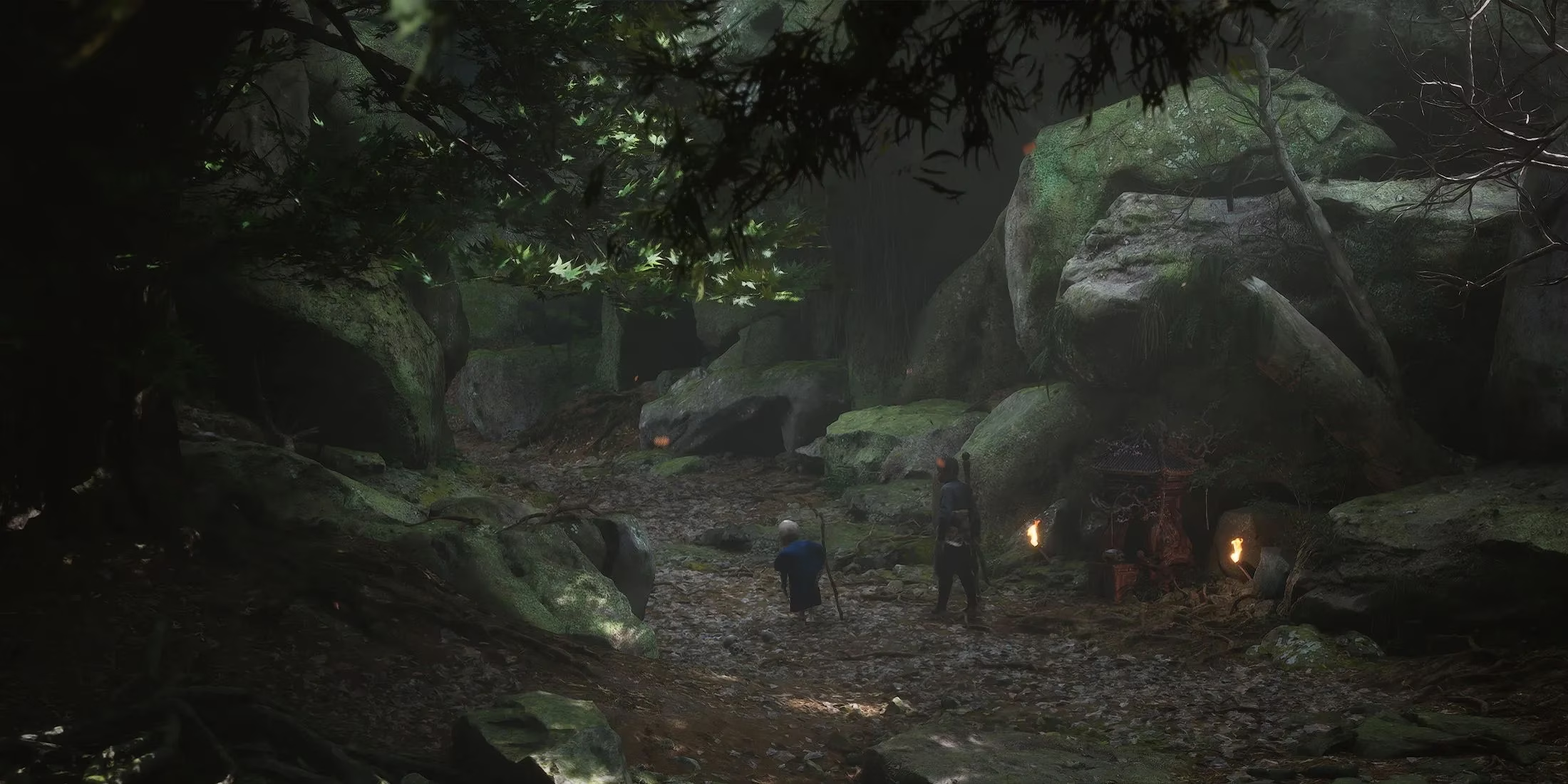
Let's talk about the good stuff first, because there is good stuff—glorious, heart-pounding good stuff. The most obvious win for a mapless world is the sheer, unbridled joy of discovery. Every hidden nook, every secret glade feels like a personal victory. You're not following a pulsating icon on a mini-map; you're following your gut, your curiosity, and the faint glow of something shiny in the distance. This approach makes stumbling upon a secret boss or a cache of legendary crafting materials an event. In fact, some of the game's most epic, sweat-inducing encounters are locked away, reserved only for those players willing to poke their nose into every last corner. It's a design philosophy that screams, "The world is yours to master," and for a while, it's utterly magical. The immersion is palpable—you're not a player looking at a map, you're the Monkey King surveying his domain.
But oh, how the mighty can stumble. That beautiful immersion? It shatters like cheap pottery the moment you sprint towards a tantalizing vista or a suspicious-looking cave entrance, only to be unceremoniously smacked in the face by... nothing. An invisible wall. Black Myth: Wukong seems to have a bizarre affection for these immersion-breaking barriers, deploying them with a frequency that feels downright archaic. It's one of the game's biggest paradoxes: it wants you to explore freely, yet it constantly slaps an invisible "Keep Out" sign on huge swathes of its beautiful scenery. This turns exploration from a joyous treasure hunt into a frustrating game of "Is this a real path or a graphical illusion?"
The problem compounds exponentially in the game's latter half. The early areas, like Black Wind Mountain, are relatively straightforward. But later regions? Buddy, they're labyrinths. We're talking multi-layered, looping, confusing mazes where distinguishing one moss-covered rock from another becomes a full-time job. You'll find yourself running in circles, absolutely certain you've been down a path before, because you have—three times. The lack of a map transforms what should be awe-inspiring exploration into a test of memory and patience. A simple trail of breadcrumbs or even a fog-of-war style map you fill in would have been a godsend.
Here’s the real kicker: the cons start to heavily outweigh the pros.
| The Good (No Map) | The Bad (No Map) |
|---|---|
| ✨ Makes discoveries feel personal and earned | 😤 Invisible walls everywhere break immersion constantly |
| 🎭 Enhances initial immersion and world presence | 🧭 Later areas are confusing mazes, leading to repetitive circling |
| 🏆 Encourages thorough, border-to-border exploration | ⏳ Wastes player time testing boundaries instead of enjoying content |
| 🎮 Aligns with a "figure it out" old-school challenge | ❓ Makes 100% completion a tedious, almost punitive chore |
The community's consensus by 2025 is pretty clear: the artistic intent is respected, but the practical execution is flawed. The game is stunning, but navigating it can feel like trying to read an ancient scroll in the dark—beautiful, but needlessly difficult. Players have spent more time headbutting invisible barriers than they have mastering some of the game's complex combat mechanics, and that's a shame.
So, what's the verdict? Black Myth: Wukong is an epic, a visual masterpiece that dares to be different. Its world begs to be explored, and for a time, the lack of a map makes that exploration thrilling. But the thrill is dampened by archaic design choices that fight against the player's curiosity. It creates a strange dissonance—the game wants you to get lost in its beauty, but then punishes you for trying. Here's hoping the developers at Game Science hear the player feedback. A simple, toggleable map in a future update wouldn't diminish the game's grandeur; it would allow more players to fully appreciate it without the unnecessary frustration. Until then, exploring this mythic world remains a breathtaking, beautiful, and occasionally bewildering journey where every step forward might just be a step into an invisible wall.