
The Celestial Dance of Staff and Shadow: Black Myth: Wukong's Poetic Combat Symphony
Black Myth: Wukong's revolutionary soulslike combat offers lightning-quick, responsive gameplay, masterfully blending Sekiro's velocity with Bloodborne's grace for an unparalleled action RPG experience.
When the first glimpse of Black Myth: Wukong shimmered into the world in 2020, it ignited a celestial fire within the soulslike community. Each subsequent revelation, each new fragment of gameplay, has fanned those flames into a roaring inferno of anticipation. Amidst a burgeoning constellation of developers inspired by FromSoftware's legacy, this title carved its own path with the promise of lightning-quick, responsive combat that defied the traditional sword-and-shield cadence of the genre. Yet, these were always impressions formed from a distance, from visions on a screen. Now, in 2026, having experienced its rhythm firsthand, the truth is a revelation: the dance feels even more sublime than it appears.
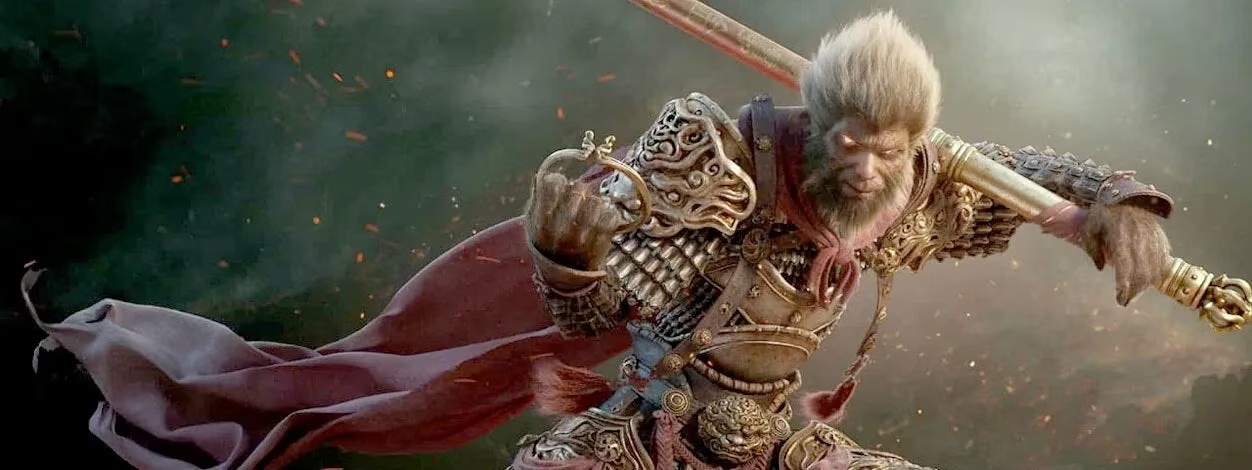
A Spectrum of Its Own: Between Sekiro's Gale and Bloodborne's Shadow
To chart the constellation where Black Myth: Wukong resides on the action RPG firmament, one must look beyond simple comparison. It undoubtedly orbits the soulslike sun, drawn by the gravitational pull of punishing, monumental boss encounters and the comforting glow of bonfire-like checkpoints. Yet, it is not a mere echo of any FromSoft creation. It exists in a poetic space between the relentless, clashing tempo of Sekiro: Shadows Die Twice and the fluid, evasive grace of Bloodborne. It borrows the former's breathless velocity and the latter's emphasis on the artful dodge, weaving them into a combat tapestry that feels uniquely its own—a sleek, mythical beast born of Chinese legend.
The soul of this system lies in motion itself. The protagonist, the legendary Sun Wukong reimagined, is a creature of perpetual momentum. He does not stand and block; he flows and evades. The absence of a traditional shield or parry is not a lack but a deliberate design choice, elevating the dodge and the leap to acts of poetic defiance. The profound satisfaction found in a perfectly timed deflection in other titles is here transmuted into the exquisite, heart-stopping joy of pirouetting away from a devastating blow at the very last possible moment. This creates a kinetic, almost balletic foundation where combat is a constant orbital dance around formidable foes.
The Staff's Song: Fluidity, Form, and Acrobatic Fury
The most wondrous aspect of this speed-centric philosophy is its unwavering sense of control. The connection between player intent and on-screen action is seamless, a direct conduit of will. This fluidity extends masterfully into the game's stance-based combat system. With a mere shift in posture, the Monkey King's staff transforms, allowing him to mix and meld disparate strike patterns into a devastating, personalized symphony of violence.
-
The Precision Thrust: One stance morphs the staff into a spear's extension, enabling lightning-fast lunges that pierce enemy defenses.
-
The Whirling Tempest: Another unlocks a spinning, area-denying assault, a blur of motion reminiscent of a Jedi's double-bladed lightsaber whirlwind.
Light attacks cascade effortlessly into spectacular heavy finishers. One might see the hero use his staff as a pole vault, launching skyward before crashing down upon his adversary. Another culminates in a breathtaking spin, the staff a centrifugal extension of his will, striking with each rotation. It is in these moments that the game's deep roots in Chinese mythology and Wuxia-inspired martial arts truly blossom. Each acrobatic feat feels earned, a direct result of player skill, transforming combat into a performance of mythical prowess.
Theatre of the Gods: Bosses as Mythic Spectacle
The game's heart beats strongest in its climactic boss confrontations, which are less mere fights and more staged mythological theatre. Encounters with entities like the Centipede Guai, the Macaque Chief, and the brutally swift Tiger Vanguard are unforgettable set-pieces. Their attack patterns are intelligently crafted puzzles of aggression, set against backdrops of staggering beauty. The Tiger Vanguard duel, for instance, takes place in a shallow pool of blood that ripples and splashes with every pounce and impact, painting the arena with each movement—a beautiful, violent canvas.
The World Between Battles: Fright Cliff and the Promise of Exploration
Beyond these spectacular duels lies the world to traverse. The Fright Cliff area, a dusty, sun-bleached landscape of canyons and fallen divinity, serves as the connective tissue. The path here snakes through arid terrain, past the colossal, half-buried remnants of Buddha statues, with incense burners acting as silent sentinels and checkpoints. While competently designed, this exploration segment can feel somewhat conventional compared to the transcendent boss fights. Enemies guard forks in the road—some with shields, others with stony craniums vulnerable to a specific, crushing stance.
One cannot help but yearn for the inventive verticality and environmental storytelling of realms like Sekiro's Sunken Valley. Given the protagonist's simian nature and his revealed ability to transform into creatures like a fly, there is potent hope that later levels will leverage his unique talents for more dynamic and engaging traversal, allowing players to truly swing and leap through this mythic world as the Monkey King should.
The Dragon's Trial: Rhythm, Precision, and Arcane Arts
The Fright Cliff culminates in a magnificent choice. One path leads to the Stone Vanguard, an optional, fun brawl against a creature assembled from boulders. The other leads behind ominous doors to the demo's true crescendo: Black Loong. This towering chimera of pig, dragon, and man is a force of deliberate, devastating power. Swinging electrified batons that shatter the very arena, he trades speed for overwhelming strength, unleashing lengthy combos that demand extended defensive ballets.
The pinnacle of this dance is a series of expanding, concentric rings of lightning that pulse outward from his form. Avoiding these requires a rhythm-action game's sense of timing—a series of perfectly judged leaps and ducks through the lethal energy. Should this electric symphony prove too daunting, the game's spell system offers a reprieve. Abilities like Immobilize can freeze Black Loong mid-attack, creating a window for counter-assault.
These incantations are not traditional sorceries but cooldown-based powers, adding strategic punctuation to encounters. They range from Cloud Step, which temporarily enhances evasive capabilities, to dramatic transformations like the Fireblade Wolf, which remakes the hero into a slower, glaive-wielding demigod. A personal favorite, The Pluck of Many, summons a miniature army of aggressive monkey clones, perfect for capitalizing on an opening created by Immobilize for a devastating burst of damage.
A Myth Forged in Fire: The Path Forward
Revealing a game years in advance is a walk along a blade's edge, risking the buildup of impossible expectations. Yet, as of 2026, Black Myth: Wukong has not merely navigated this risk; it has soared above it. It is crystallizing into one of the most thrilling action RPGs of its era, offering a fresh, kinetic, and visually stunning interpretation of the soulslike challenge. The celestial dance of its combat is assured. The remaining verses of its epic—the depth of its wider RPG systems for character growth, and the design of its world beyond the demo's glimpses—will determine if this myth ascends to the legendary status its breathtaking combat so richly promises.